
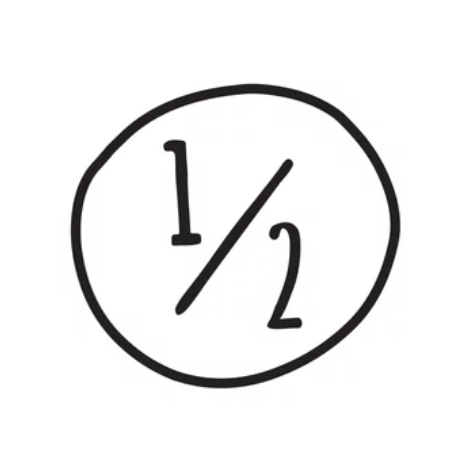
Fractions are fundamental to mathematics and science, serving as tools to represent parts of a whole. Among these, half fractions—fractions where the numerator is 1 and the denominator is 2 (e.g., 1/2)—hold a unique position in various scientific disciplines. The simplicity of half fractions makes them ideal for simplifying complex calculations and making precise measurements. In scientific research and data analysis, half fractions often play a crucial role, helping scientists to communicate findings accurately and interpret measurements with greater precision. This post explores the applications of half fractions in different fields of science, focusing on their role in measurements, data analysis, and practical uses in experimental procedures.
Check out our Half Fractions Calculator
Understanding Half Fractions in Science
Before delving into the specific applications, it’s important to understand what half fractions are. A half fraction represents dividing a whole into two equal parts, where each part is \( \frac{1}{2} \) of the whole. It is a basic yet powerful concept that provides a foundation for understanding other fractions. In scientific contexts, this simplicity allows half fractions to be used in calculations, measurements, and data interpretation with ease.
Importance of Half Fractions in Scientific Measurements
Precision in Measurements
Scientific experiments and observations often require precise measurements to ensure accurate results. Half fractions come into play when scientists measure quantities that are not whole numbers, such as distances, weights, or time intervals. For example, in physics, distances or lengths may be measured using devices that give readings in increments of \( \frac{1}{2} \) meters or centimeters. This allows for a more granular understanding of physical dimensions, leading to more accurate experimental outcomes.
In fields like chemistry, where measuring substances in precise quantities is essential, half fractions can be crucial. When preparing solutions or compounds, scientists often use measurements like \( \frac{1}{2} \) liter or \( \frac{1}{2} \) mole. This ensures that the ratios of chemicals remain consistent, which is critical for maintaining the integrity of chemical reactions and outcomes.
Application in Time Measurements
Time measurement is another area where half fractions play a significant role. For instance, time intervals of \( \frac{1}{2} \) seconds are frequently used in studies involving motion, such as in kinematic equations or physics experiments. Recording time to the nearest \( \frac{1}{2} \) second helps scientists analyze speed, velocity, and acceleration more precisely. This level of precision is essential for experiments involving pendulums, free-fall motions, and other phenomena where small changes in time can greatly affect the results.
Data Analysis with Half Fractions
Interpreting Data Trends
In scientific data analysis, half fractions help in understanding trends and relationships between variables. For instance, when analyzing statistical data, half fractions might be used in rounding off values for easier interpretation. If a dataset includes values like 4.7, 5.2, and 5.6, these can be rounded to the nearest \( \frac{1}{2} \), making it simpler to visualize patterns and trends.
Moreover, in regression analysis and curve fitting, which are common in fields like biology and economics, half fractions can be used to simplify data points. For instance, scientists might use \( \frac{1}{2} \) as a common interval when creating a regression line or a graph to represent data points. This helps in visualizing relationships between variables without overwhelming detail, making the data easier to interpret and analyze.
Simplifying Complex Calculations
In complex scientific calculations, using half fractions can simplify the process of deriving equations or interpreting results. For example, in thermodynamics, scientists often deal with partial pressures, temperatures, and volumes that can be expressed as fractions. Using \( \frac{1}{2} \) as a reference point makes it easier to scale these values or convert them into simpler units, facilitating more manageable calculations.
In physics, half fractions are often encountered when applying formulas like kinetic energy, where factors are halved to simplify the derivation. For example, the formula for kinetic energy is \( KE = \frac{1}{2} mv^2 \). Here, the \( \frac{1}{2} \) factor adjusts for the relationship between mass (\( m \)) and velocity (\( v \)) squared, making the formula more accurate when predicting the energy of moving objects.
Applications of Half Fractions in Different Scientific Fields
Physics: Calculations and Measurements
In physics, half fractions are frequently encountered in equations and measurements. One notable example is in the calculation of average speed, where scientists use time intervals like \( \frac{1}{2} \) seconds or \( \frac{1}{2} \) meters to gain a more precise understanding of motion. For instance, when calculating the speed of a car over short intervals, scientists might use a time interval of \( \frac{1}{2} \) seconds to capture small variations in speed that occur during the experiment.
Another example is in wave mechanics, where half fractions can be used to measure wavelengths or frequencies. A wave might have a frequency that is \( \frac{1}{2} \) of another, which helps scientists compare and contrast the behavior of different waves. This is particularly useful in fields like acoustics and electromagnetism, where understanding wave patterns is essential.
Chemistry: Preparing Solutions and Compounds
In chemistry, precision is key when preparing solutions, and half fractions often help to achieve this accuracy. For example, when diluting a solution, chemists might use \( \frac{1}{2} \) liter of a solvent to create a mixture with the desired concentration. This ensures that the ratio of solute to solvent is exact, which is critical for maintaining the intended chemical properties of the solution.
Chemists also use half fractions when measuring substances on a molecular scale, such as using \( \frac{1}{2} \) mole to determine the quantity of a reactant in a chemical reaction. This ensures that reactions proceed as expected, minimizing the risk of errors that could alter the outcome of experiments.
Biology: Statistical Analysis and Population Studies
In biology, half fractions are often used in statistical analysis and population studies. For example, when calculating the growth rate of a population, biologists might use half fractions to represent average birth or death rates over specific time periods. This allows for more precise modeling of population changes, which is important for understanding species dynamics and ecosystem health.
Half fractions also appear in genetics, where scientists analyze the probability of certain traits being passed from parents to offspring. For example, the probability of inheriting a certain trait might be represented as \( \frac{1}{2} \), indicating that there is a 50% chance of inheriting that trait. This simple representation helps to convey complex genetic information in an accessible way.
Real-World Examples of Half Fractions in Science
Medicine and Pharmacology
In medicine and pharmacology, half fractions play an important role in dosage calculations and treatment plans. For instance, doctors often prescribe medications in doses like \( \frac{1}{2} \) pill or \( \frac{1}{2} \) teaspoon. This ensures that patients receive the precise amount of medication needed for effective treatment, reducing the risk of underdosing or overdosing.
Half fractions also appear in clinical studies, where researchers use them to represent half-lives of drugs. Understanding a drug’s half-life—how long it takes for half of the drug to be eliminated from the body—helps in determining the appropriate dosage and frequency for patients, ensuring safety and efficacy.
Engineering: Design and Construction
In engineering, half fractions are used in the design and construction of structures. For example, when creating blueprints or scaling models, engineers might use measurements like \( \frac{1}{2} \) inch or \( \frac{1}{2} \) meter to ensure that designs are accurate. This level of precision helps in creating models that accurately represent the intended structures.
In materials science, engineers use half fractions when measuring stress and strain in materials, helping them to predict how materials will behave under different conditions. This ensures that structures are built to withstand various forces, contributing to the safety and stability of buildings and machinery.
Try out our Online Calculators and Tools
The Essential Role of Half Fractions in Science
Half fractions may seem simple, but they are a powerful tool in scientific research, measurements, and data analysis. Their ability to represent precise parts of a whole makes them invaluable in fields ranging from physics and chemistry to biology and engineering. By using half fractions, scientists can achieve greater accuracy in their measurements and calculations, leading to more reliable results and better understanding of the natural world. As science continues to advance, the role of these fundamental fractions will remain crucial in pushing the boundaries of what we know.