
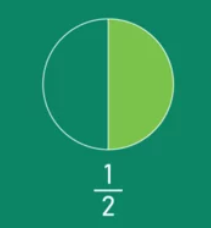
The Common Core State Standards (CCSS) have been implemented across many U.S. states to provide a consistent and clear understanding of what students are expected to learn, particularly in subjects like mathematics. Fractions play a critical role in the mathematics standards from elementary grades onwards, helping students build a strong foundation in number sense and rational number concepts. Among these, half fractions, like 1/2, serve as a fundamental starting point for understanding fractions more broadly. This blog post explores how half fractions fit within the Common Core framework for mathematics and how educators can effectively teach these concepts to align with the standards.
Check out our Half Fractions Calculator
What Are the Common Core Standards for Fractions?
The Common Core State Standards for fractions aim to ensure that students develop a deep understanding of fractions as numbers. This includes recognizing fractions on a number line, understanding equivalence, and using fractions in operations such as addition, subtraction, multiplication, and division. The standards gradually increase in complexity as students move through grades, starting from basic fraction concepts in Grade 3 to more advanced operations in Grades 4 and 5.
For example, by Grade 3, students are expected to understand fractions as a part of a whole, compare fractions with the same denominator, and place fractions on a number line. By Grade 4, they should be able to recognize equivalent fractions and add or subtract fractions with the same denominators. In Grade 5, the focus shifts to operations with fractions, including multiplication and division.
Role of Half Fractions in the Common Core
Half fractions, represented as \( \frac{1}{2} \), are often one of the first fractions introduced to students. They serve as an anchor point for understanding other fractions, making them essential in the Common Core’s approach to teaching fractions. Here are a few ways in which half fractions are emphasized within the Common Core framework:
- Building Conceptual Understanding: The introduction of \( \frac{1}{2} \) helps students understand the idea of dividing a whole into equal parts. By visualizing a whole split into two equal sections, students grasp the meaning of what fractions represent. This understanding is foundational for learning other fractions like \( \frac{1}{4} \) or \( \frac{3}{4} \).
- Equivalence and Comparisons: Half fractions are pivotal when teaching students about equivalent fractions. For example, the equivalence of \( \frac{2}{4} \) and \( \frac{1}{2} \) is often used as a practical illustration. By using models, such as fraction bars or circles, students can visually see that \( \frac{2}{4} \) occupies the same amount of space as \( \frac{1}{2} \). This understanding of equivalence is critical in meeting the Common Core standards for Grade 3 and Grade 4.
- Application in Operations: The simplicity of \( \frac{1}{2} \) makes it a common example in teaching operations involving fractions. Whether it’s adding \( \frac{1}{2} \) to another fraction or multiplying a whole number by \( \frac{1}{2} \), students frequently encounter this fraction in exercises that meet Common Core requirements. For example, in Grade 5, students are expected to multiply a fraction by a whole number, and using \( \frac{1}{2} \) can make these calculations more intuitive.
Teaching Strategies for Half Fractions Aligned with Common Core
Understanding the role of half fractions in the Common Core is one thing, but effectively teaching them is another. Here are some strategies for educators to teach half fractions in alignment with the Common Core standards:
1. Visual Models and Manipulatives
Visual aids, like fraction bars, number lines, and pie charts, are instrumental in helping students understand \( \frac{1}{2} \). According to the Common Core standards, using visual fraction models is essential in Grades 3 and 4 to build a strong conceptual understanding of fractions. When students see \( \frac{1}{2} \) represented as half of a circle or as a point on a number line, they better understand what the fraction represents.
Teachers can use digital tools and interactive activities that allow students to manipulate fractions. For instance, showing how two \( \frac{1}{4} \) sections make up \( \frac{1}{2} \) helps students grasp the concept of equivalence through hands-on learning.
2. Real-World Examples
Common Core emphasizes the practical application of mathematical concepts, and half fractions are a natural fit for real-world contexts. Teachers can introduce scenarios like sharing food, measuring ingredients in cooking, or dividing a dollar into half-dollar coins. These examples make the abstract concept of \( \frac{1}{2} \) more concrete and relatable for students.
For example, an exercise could involve dividing a pizza into two equal slices and then further into four slices, showing that each slice is \( \frac{1}{4} \) and that two slices make \( \frac{2}{4} \), which is equivalent to \( \frac{1}{2} \).
3. Number Line Integration
The Common Core standards highlight the importance of placing fractions on a number line. Introducing \( \frac{1}{2} \) on a number line helps students visualize how fractions fit within the whole numbers. They can see that \( \frac{1}{2} \) lies halfway between 0 and 1, which reinforces their understanding of fractions as numbers.
Number lines can also be used to compare \( \frac{1}{2} \) with other fractions like \( \frac{3}{4} \) or \( \frac{1}{4} \), helping students develop a sense of fraction size and order.
Common Core Standards: Specific Grade-Level Focus
Grade 3: Introduction to Fractions
In Grade 3, students begin to understand fractions as numbers, and \( \frac{1}{2} \) serves as a simple example of a fraction that represents one part of a whole. Students learn to partition shapes into equal parts, such as dividing a rectangle into two equal parts to show \( \frac{1}{2} \).
Activities like shading half of a shape or locating \( \frac{1}{2} \) on a number line help students meet standards like 3.NF.A.1 (understanding a fraction as a part of a whole) and 3.NF.A.2 (understanding fractions on a number line).
Grade 4: Understanding Equivalence
By Grade 4, students dive deeper into the concept of equivalent fractions. Using \( \frac{1}{2} \) as a reference point, they explore how fractions like \( \frac{2}{4} \) or \( \frac{3}{6} \) can be equivalent to \( \frac{1}{2} \). This aligns with the standard 4.NF.A.1, which emphasizes recognizing and generating equivalent fractions.
Teachers can use visual models and encourage students to simplify fractions to see their equivalence with \( \frac{1}{2} \). For example, dividing both the numerator and denominator of \( \frac{4}{8} \) by 4 yields \( \frac{1}{2} \).
Grade 5: Operations with Fractions
In Grade 5, students start working with addition, subtraction, multiplication, and division of fractions. Understanding \( \frac{1}{2} \) is key to solving problems that involve multiplying or dividing fractions by whole numbers. This knowledge helps meet standards like 5.NF.B.4 (multiplying fractions) and 5.NF.B.6 (real-world problems involving fractions).
For example, if a student needs to multiply \( 6 \times \frac{1}{2} \), understanding that the product is 3 becomes a stepping stone to more complex fraction operations.
Why Understanding Half Fractions Is Important
Half fractions might seem basic, but they are a gateway to mastering more complex fractional concepts. By understanding \( \frac{1}{2} \), students can more easily grasp concepts like equivalence, benchmarks, and operations with fractions. This solid foundation supports their ability to meet the Common Core standards for fractions and prepares them for more advanced mathematical concepts.
Try out our Online Calculators and Tools
The Common Core standards for fractions emphasize a deep understanding of fractions, with half fractions playing a critical role in building students’ conceptual foundations. From visual models to real-world applications, 1/2 is a versatile teaching tool that helps students progress through the standards in Grades 3, 4, and 5. By mastering the concept of half fractions, students gain the confidence to tackle more challenging fractions and operations, setting them up for success in mathematics. For educators, focusing on half fractions is not just about meeting standards—it’s about empowering students with the skills they need to think mathematically in everyday life.