
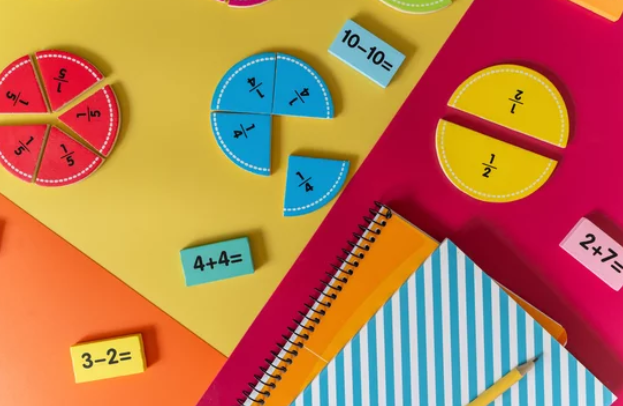
Geometry is a fundamental branch of mathematics that explores shapes, sizes, and the properties of space. Within this domain, fractions often play a crucial role, especially half fractions. Understanding how to use half fractions in geometry can deepen one’s grasp of key concepts, such as calculating areas, perimeters, and proportions. This post will explore the significance of half fractions in geometry, providing a clear understanding of their application in various scenarios.
What Are Half Fractions?
Half fractions represent the division of a whole into two equal parts, commonly denoted as \( \frac{1}{2} \). This fraction is often the first encountered in elementary math, making it a foundational concept for further mathematical understanding. While simple in its representation, \( \frac{1}{2} \) holds great importance in geometry, where dividing shapes into equal parts is common. From determining the midpoint of a line segment to calculating half of a rectangle’s area, understanding half fractions allows for more efficient geometric calculations.
Importance of Half Fractions in Geometry
Half fractions serve as a bridge between abstract mathematical concepts and practical real-world applications. Geometry, as a visual and spatial form of mathematics, often requires breaking down shapes into manageable parts for easier calculation. For instance, when calculating the area of a triangle, a common formula involves multiplying the base by the height and then dividing the result by two. This division by two is an application of half fractions, demonstrating how geometry uses this simple concept to reach accurate measurements.
By understanding half fractions, students and professionals can more easily simplify complex problems, ensuring precision in their work. Furthermore, mastering half fractions helps with recognizing patterns and relationships between different geometric shapes and forms.
Half Fractions in Calculating Area
One of the most common applications of half fractions in geometry is in the calculation of areas. Here are a few examples where half fractions are directly applied:
-
Area of a Triangle: The formula for finding the area of a triangle is:
\( \text{Area} = \frac{1}{2} \times \text{Base} \times \text{Height} \)
This formula arises because a triangle is effectively half of a parallelogram with the same base and height. Dividing by \( \frac{1}{2} \) helps to calculate just the triangular part. -
Area of a Circle Sector: When dealing with a sector of a circle, which is a slice or part of a circle, the area is often derived using a fraction of the total area of the circle. For example:
\( \text{Area of Sector} = \frac{\theta}{360} \times \pi r^2 \)
If the sector represents half of the circle (i.e., \( \theta = 180 \) degrees), then it becomes:
\( \text{Area} = \frac{1}{2} \times \pi r^2 \)
Here, \( \frac{1}{2} \) represents the fraction of the circle’s area that the sector occupies. -
Area of a Trapezoid: The formula for finding the area of a trapezoid involves a half fraction as well:
\( \text{Area} = \frac{1}{2} \times ( \text{Base}_1 + \text{Base}_2 ) \times \text{Height} \)
The \( \frac{1}{2} \) arises from averaging the two bases, reflecting that a trapezoid can be thought of as half of a parallelogram if extended.
Understanding Half Fractions in Perimeter Calculations
Although half fractions are more commonly used in area calculations, they also appear in perimeter and length calculations in specific scenarios:
-
Midpoint of a Line Segment: The concept of a midpoint involves finding the halfway point between two endpoints of a line segment. If a line segment is denoted by its endpoints \( (x_1, y_1) \) and \( (x_2, y_2) \), the midpoint can be calculated as:
\( M = \left( \frac{x_1 + x_2}{2}, \frac{y_1 + y_2}{2} \right) \)
This formula shows how half fractions play a role in dividing the segment into two equal parts, a concept frequently used in geometry for constructing bisectors and symmetry. - Dividing Shapes into Equal Parts: In geometric constructions, it is often necessary to divide a shape, such as a square or rectangle, into equal parts. For instance, dividing a square into two equal rectangles involves using a line that halves one of the dimensions, effectively applying a half fraction to calculate the new perimeter and dimensions of each part.
Real-World Examples of Half Fractions in Geometry
Half fractions find their applications in many real-life situations, from architecture to design and even nature. Here are some everyday examples of how half fractions and geometry go hand in hand:
- Architecture and Design: Architects often need to divide space into equal parts when designing a building or room layout. For example, dividing a rectangular room into two smaller rooms requires understanding how the original area is halved. This involves calculating \( \frac{1}{2} \) of the room’s length or width, ensuring that each smaller room retains the desired dimensions.
- Landscaping and Gardening: When planning a garden or park, designers use geometric principles to divide space into sections, such as flower beds or seating areas. If a garden is divided into two equal plots, the designer uses half fractions to ensure that each section is symmetrical, leading to a more aesthetically pleasing and balanced layout.
- Cutting Materials in Construction: In construction, workers often cut materials like wood or metal into smaller sections. For instance, if a beam needs to be cut in half, understanding how to measure half accurately ensures precision and reduces waste. This process involves applying the concept of half fractions to achieve the desired length.
- Cooking and Recipes: Recipes often call for ingredients to be halved or doubled, requiring a basic understanding of fractions. While not strictly geometric, the concept of dividing a quantity into two equal parts is a direct application of the half fraction principle. It’s especially relevant when adjusting recipes to accommodate a different number of servings.
Tips for Mastering Half Fractions in Geometry
For students and educators alike, mastering half fractions is key to excelling in geometry. Here are some tips for understanding and applying half fractions:
- Practice with Visual Models: Visual models, such as pie charts, grid diagrams, and geometry software, can help visualize how dividing shapes into halves affects their dimensions. This can make it easier to understand the concept of half fractions in a tangible way.
- Focus on Real-World Problems: Applying half fractions to real-world problems, like those in architecture or design, can make learning more engaging. It helps students see the practical side of math and how geometry is used outside of the classroom.
- Use Worksheets and Practice Exercises: Worksheets that involve calculating areas, perimeters, and midpoints are valuable tools for reinforcing the concept of half fractions. Online resources often provide exercises that focus on these specific calculations, helping students build their skills.
- Connect with Other Fraction Concepts: Half fractions are just one part of a broader set of fraction concepts used in math. Connecting the understanding of \( \frac{1}{2} \) with other fractions, such as \( \frac{1}{4} \) or \( \frac{3}{4} \), can help solidify a more comprehensive understanding of fractions as a whole.
The Power of Half Fractions in Geometry
Half fractions may seem simple, but they hold immense value in geometry. Whether calculating the area of a triangle, finding the midpoint of a line, or dividing a shape into equal parts, understanding how to work with half fractions allows for more accurate measurements and problem-solving. As a foundational concept in math, mastering half fractions helps students and professionals alike excel in geometry and appreciate the practical applications of mathematical principles in the world around them.