
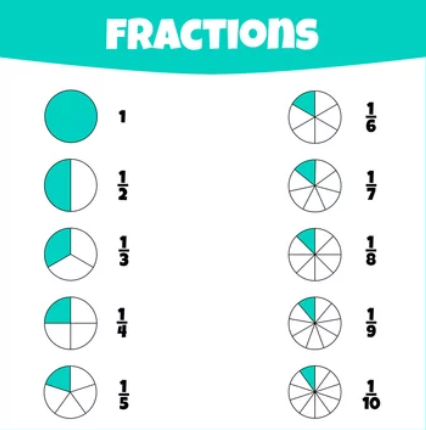
Fractions are essential in mathematics, representing parts of a whole. While fractions are a fundamental concept, comparing and ordering them can sometimes be tricky, especially when fractions like half come into play. In this blog post, we will explore various techniques for comparing half fractions (1/2) with other fractions and provide clear steps to help you master this important skill. Whether you’re working with simple fractions or more complex ones, these strategies will simplify the process.
Check out our Half Fractions Calculator
1. Understanding Half Fractions
Before diving into comparison techniques, it’s essential to understand what a half fraction represents. A fraction like \( \frac{1}{2} \) indicates that you have one part out of two equal parts of a whole. For example, cutting a pizza in half would give you two equal slices, and one slice represents \( \frac{1}{2} \).
In mathematical terms, \( \frac{1}{2} \) is considered a benchmark fraction, as many other fractions can be easily compared to it. Knowing how to relate other fractions to half is crucial when solving fraction problems.
2. Comparing Fractions with the Same Denominators
One of the simplest methods for comparing fractions is when they have the same denominator. If two fractions share the same denominator, you can compare their numerators directly. The fraction with the larger numerator is the greater fraction.
For example, consider comparing \( \frac{1}{2} \) and \( \frac{3}{4} \). Both fractions have a denominator of 4:
\( \frac{2}{4} \) (equivalent to \( \frac{1}{2} \))
\( \frac{3}{4} \)
Since 3 is greater than 2, \( \frac{3}{4} \) is greater than \( \frac{1}{2} \).
3. Comparing Fractions with Different Denominators
When fractions have different denominators, like \( \frac{1}{2} \) and \( \frac{3}{5} \), the process becomes more complex. To compare them, you need to find a common denominator. This involves converting the fractions to have the same denominator, then comparing their numerators.
Steps for Comparing Fractions with Different Denominators:
- Find the Least Common Denominator (LCD): Identify the least common denominator of the two fractions. For example, the denominators of \( \frac{1}{2} \) and \( \frac{3}{5} \) are 2 and 5. The LCD for 2 and 5 is 10.
- Convert Fractions to Have the Same Denominator: Convert each fraction to an equivalent fraction with the LCD as the denominator.
\( \frac{1}{2} = \frac{5}{10} \)
\( \frac{3}{5} = \frac{6}{10} \)
- Compare the Numerators: Now that the fractions have the same denominator, you can directly compare the numerators. Since 6 is greater than 5, \( \frac{3}{5} \) is greater than \( \frac{1}{2} \).
4. Cross-Multiplication Method
Another technique for comparing fractions is the cross-multiplication method, which works particularly well when fractions have different denominators. This method eliminates the need to find the least common denominator and allows for quick comparisons.
Steps for Cross-Multiplication:
- Multiply the numerator of the first fraction by the denominator of the second fraction.
- Multiply the numerator of the second fraction by the denominator of the first fraction.
- Compare the two products to determine which fraction is larger.
For example, compare \( \frac{1}{2} \) and \( \frac{5}{8} \):
\( 1 \times 8 = 8 \)
\( 5 \times 2 = 10 \)
Since 10 is greater than 8, \( \frac{5}{8} \) is greater than \( \frac{1}{2} \).
5. Decimal Conversion
Sometimes, converting fractions to decimals is a straightforward way to compare them. This technique is especially helpful when working with multiple fractions or when precision is required.
Steps for Decimal Conversion:
- Divide the numerator by the denominator to convert each fraction into a decimal.
- Compare the decimal values to determine which fraction is larger.
For example:
\( \frac{1}{2} = 0.5 \)
\( \frac{3}{4} = 0.75 \)
Since 0.75 is greater than 0.5, \( \frac{3}{4} \) is greater than \( \frac{1}{2} \).
6. Visual Models and Number Lines
For those who find visual learning more effective, using models or number lines can help compare fractions. Drawing a fraction on a number line or using visual aids like fraction bars can provide a clearer picture of how fractions relate to each other.
Steps for Using a Number Line:
- Draw a number line and mark points representing 0, \( \frac{1}{2} \), and 1.
- Plot each fraction on the number line by dividing it into the appropriate number of equal parts.
- Compare the positions of the fractions. Fractions to the right of \( \frac{1}{2} \) are greater than \( \frac{1}{2} \), while fractions to the left are smaller.
For example, plotting \( \frac{1}{2} \) and \( \frac{5}{6} \) on a number line would show that \( \frac{5}{6} \) is closer to 1, making it larger than \( \frac{1}{2} \).
7. Benchmarking with Half
When comparing fractions to \( \frac{1}{2} \), benchmarking is a useful technique. This involves estimating whether a fraction is less than, equal to, or greater than \( \frac{1}{2} \) based on its numerator and denominator.
For example:
\( \frac{2}{3} \): The numerator is more than half of the denominator, so this fraction is greater than \( \frac{1}{2} \).
\( \frac{3}{8} \): The numerator is less than half of the denominator, so this fraction is less than \( \frac{1}{2} \).
Benchmarking is a quick mental method for comparing fractions and works especially well for simple fractions.
8. Common Fraction Comparisons with Half
Here are some common fractions and their comparisons with \( \frac{1}{2} \):
- \( \frac{1}{3} \): Less than \( \frac{1}{2} \) (since \( 0.33 < 0.5 \)).
- \( \frac{2}{3} \): Greater than \( \frac{1}{2} \) (since \( 0.67 > 0.5 \)).
- \( \frac{3}{4} \): Greater than \( \frac{1}{2} \) (since \( 0.75 > 0.5 \)).
- \( \frac{1}{4} \): Less than \( \frac{1}{2} \) (since \( 0.25 < 0.5 \)).
By remembering the decimal equivalents of common fractions, you can quickly compare them to \( \frac{1}{2} \).
Try out our Online Calculators and Tools
Comparing and ordering fractions, especially when half fractions are involved, doesn’t have to be difficult. By using techniques like finding a common denominator, cross-multiplication, decimal conversion, and visual aids, you can confidently compare fractions. Whether you’re working with simple or complex fractions, mastering these strategies will make fraction comparisons a breeze.