
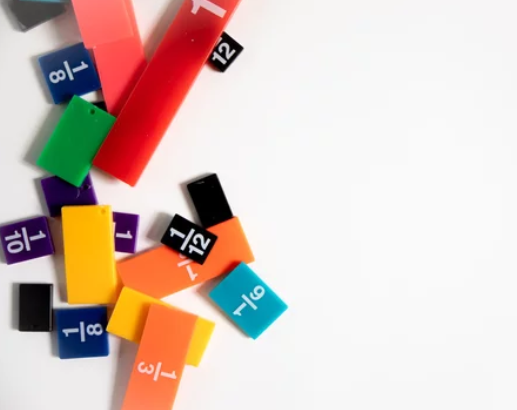
Understanding fractions is a fundamental skill in mathematics, and teaching half fractions effectively can set the stage for a student’s success in more complex concepts. Half fractions, represented as 1/2, are one of the first fractions students encounter. This blog post will explore effective strategies for educators to teach half fractions to different age groups, ensuring students grasp the concept in engaging and meaningful ways.
Check out our Half Fractions Calculator
The Importance of Half Fractions in Mathematics
Half fractions are foundational in understanding the broader concept of fractions as parts of a whole. Mastery of \(\frac{1}{2}\) allows students to:
- Understand equivalent fractions (e.g., \(\frac{2}{4} = \frac{1}{2}\)).
- Gain insight into fraction addition and subtraction.
- See the relationship between fractions and whole numbers.
- Grasp the concept of dividing a whole into equal parts.
These skills are essential as they pave the way for more advanced topics such as division, ratios, and percentages.
Effective Strategies for Teaching Half Fractions
1. Start with Visual Aids
Visual aids are critical for teaching fractions, especially for younger learners. Using pictures, diagrams, and hands-on activities can help students better understand how a fraction like \(\frac{1}{2}\) divides a whole into two equal parts.
Using Pie Charts
Pie charts are one of the most effective tools for teaching fractions because they visually represent the idea of dividing a whole into parts. Start with a whole pie (or circle) and ask students to imagine dividing it in half. By coloring one half or cutting the pie into two equal sections, students can see that one part out of two equals \(\frac{1}{2}\).
You can also expand the activity to show equivalent fractions. For instance, divide the pie into four parts and shade two parts to show that \(\frac{2}{4}\) is equivalent to \(\frac{1}{2}\). This visual representation reinforces the concept that fractions can be represented in different ways while still holding the same value.
Using Number Lines
Number lines provide a different, linear perspective on fractions. Draw a number line from 0 to 1 and mark the midpoint as \(\frac{1}{2}\). Show students that \(\frac{1}{2}\) is halfway between 0 and 1, emphasizing that fractions are part of a whole.
Expand this activity by marking equivalent fractions on the number line, such as \(\frac{2}{4}\) or \(\frac{3}{6}\), and demonstrate how they all align with \(\frac{1}{2}\). This approach helps students visualize the relationship between fractions and whole numbers.
2. Use Real-Life Examples
One of the best ways to teach half fractions is by using real-life examples that students can relate to. By connecting the concept of half to everyday experiences, you make fractions more accessible and less abstract.
Food-Based Examples
Food items, such as pizza, pies, or sandwiches, are perfect for illustrating fractions. For example, ask students to imagine cutting a pizza in half. If one person eats half the pizza, they have consumed \(\frac{1}{2}\) of the whole.
You can also introduce more complex examples by dividing food into quarters or eighths and discussing how \(\frac{1}{2}\) relates to these other fractions. For instance, if you cut a sandwich into four pieces and eat two, you’ve eaten \(\frac{2}{4}\), which is equivalent to \(\frac{1}{2}\).
Measuring in Cooking
Another real-life example is cooking or baking. Recipes often call for fractions of ingredients (e.g., half a cup of sugar). Use these examples to show students how fractions are applied in everyday tasks and why understanding \(\frac{1}{2}\) is important in practical situations.
3. Incorporate Interactive Games and Activities
Interactive games and hands-on activities make learning fractions more engaging and fun. By incorporating movement and friendly competition, students become more motivated to practice and understand the concept of half fractions.
Fraction Bingo
Create bingo cards with different fractions, including \(\frac{1}{2}\). As the teacher, call out fractions, and students must match the fractions on their bingo cards. This game reinforces fraction recognition and equivalence, especially for half fractions.
Memory Match
Create cards with different representations of \(\frac{1}{2}\) (e.g., 0.5, \(\frac{2}{4}\), 50%). Lay the cards face down, and have students take turns flipping two cards to find a matching pair. This activity reinforces the concept that \(\frac{1}{2}\) can be represented in multiple ways.
Fraction Relay Race
In this activity, divide students into teams and set up fraction stations around the classroom. Each station includes a fraction challenge, such as placing \(\frac{1}{2}\) on a number line or solving a simple fraction equation. Teams race from station to station, completing the challenges as quickly as possible. The first team to finish all the stations wins. This game combines physical activity with fraction learning, making it ideal for kinesthetic learners.
4. Emphasize Fraction Equivalence
Understanding fraction equivalence is critical for mastering fractions. Once students grasp half fractions, introduce equivalent fractions like \(\frac{2}{4}\), \(\frac{3}{6}\), and \(\frac{4}{8}\).
Using Visuals for Equivalence
Use both pie charts and number lines to show how different fractions can represent the same value. On a number line, for instance, show how \(\frac{2}{4}\), \(\frac{3}{6}\), and other fractions align with \(\frac{1}{2}\). Visually, students will see that these fractions occupy the same place on the number line, reinforcing their understanding of equivalence.
Games to Teach Equivalence
Games like “Fraction War” (a card game where students compare fractions) can help reinforce the concept of equivalence. Create fraction cards, including several representations of \(\frac{1}{2}\). Students compare their cards, and the one with the larger fraction wins. This game encourages students to think critically about the size of fractions and how they compare to \(\frac{1}{2}\).
5. Address Common Misconceptions
Fractions can be confusing, and students may develop misconceptions, especially regarding half fractions. Here are a few common misconceptions and how to address them:
- Misconception: \(\frac{1}{2}\) means “one” – Some students may mistakenly believe that \(\frac{1}{2}\) represents the number 1. Clarify that \(\frac{1}{2}\) represents one part out of two equal parts and that it’s less than 1.
- Misconception: Larger denominators mean larger fractions – Some students may assume that a fraction with a larger denominator is larger. For example, they might think \(\frac{1}{4}\) is bigger than \(\frac{1}{2}\). Use number lines or pie charts to show that \(\frac{1}{2}\) is larger than \(\frac{1}{4}\), as it represents a larger portion of the whole.
Try out our Online Calculators and Tools
Teaching half fractions effectively requires a blend of visual aids, real-life examples, interactive activities, and addressing misconceptions. By implementing these strategies, educators can help students develop a solid understanding of half fractions, laying the groundwork for more advanced mathematical concepts. Engaging students in learning fractions not only enhances their skills but also instills confidence and enthusiasm in their mathematical abilities. Through creativity and patience, educators can make the journey of learning about half fractions enjoyable and impactful.