
Fractions, where the numerator is larger than or equal to the denominator, are known as improper fractions. They are called “improper” because they break the traditional rule that the numerator should always be less than the denominator. Despite their name, improper fractions are an important mathematical concept that can be used in many real-world applications. In this blog post, we will explore the definition of improper fractions, their relationship to mixed numbers, and their use in practical situations.
Definition of Improper Fractions
A fraction is considered improper when its numerator is larger than or equal to its denominator. For example, 5/4, 7/3, and 12/7 are all improper fractions. On the other hand, a proper fraction is a type of fraction where the numerator is smaller than the denominator. For example, 1/4, 2/3, and 5/6 are all proper fractions.
Check out the Fraction Simplifier

Relationship Between Improper Fractions and Mixed Numbers
A mixed number comprises a whole number and a proper fraction. For example, 2 1/2 is a mixed number, where the whole number is 2 and the proper fraction is 1/2. Mixed numbers can also be converted to improper fractions. When transforming a mixed number into an improper fraction, you need to multiply the whole number by the denominator and then add the numerator. This sum will be the numerator of the improper fraction, while the denominator stays constant.
For example, to convert 2 1/2 to an improper fraction, you would multiply 2 by 2, which equals 4. Next, you add 1 to 4, which equals 5. So, 2 1/2 can be written as the improper fraction 5/2.
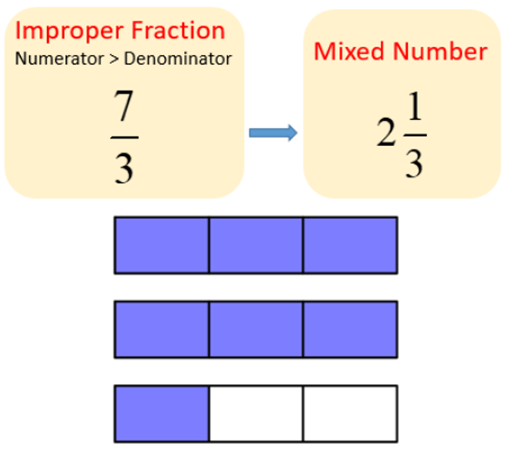
Conversely, to convert an improper fraction to a mixed number, you divide the numerator by the denominator, and the whole number is the quotient. The remainder becomes the numerator of the proper fraction, and the denominator remains the same.
For example, to convert 9/4 to a mixed number, you would divide 9 by 4, which equals 2 with a remainder of 1. So, the mixed number is 2 1/4.
Adding and Subtracting Improper Fractions
Adding and subtracting improper fractions can seem daunting, but the process is straightforward. To begin, you must identify a shared denominator for the fractions that are being added or subtracted. To do this, you multiply the denominators of the fractions together. For example, if you’re adding 5/6 and 7/8, you would multiply 6 and 8 together, which equals 48. Next, you convert each fraction to an equivalent fraction with the common denominator. To do this, you multiply the numerator and denominator of each fraction by the same number which makes the denominator equal to the common denominator.
For example, to add 5/6 and 7/8, you would multiply the numerator and denominator of 5/6 by 8, giving you 40/48, and you would multiply the numerator and denominator of 7/8 by 6, giving you 42/48. Then, you add the two fractions together by adding the numerators and keeping the denominator the same, which equals 82/48.
After finding the sum or difference of the fractions, you may need to simplify the fraction. To do this, you divide the numerator and denominator by their greatest common factor.
For example, to simplify 82/48, you would divide both the numerator and denominator by 2, giving you 41/24.
Try out the Half Fractions Calculator
Multiplying and Dividing Improper Fractions
Multiplying and dividing improper fractions is a simpler process than adding and subtracting them. To multiply two improper fractions, you multiply their numerators and denominators separately, without finding a common denominator first. For example, to multiply 4/3 and 5/2, you would multiply the numerators together (4 x 5 = 20) and the denominators together (3 x 2 = 6). So the answer is 20/6. However, this answer can be simplified. The highest common factor shared by 20 and 6 is 2. So, dividing both the numerator and denominator by 2 gives you the simplified answer of 10/3.
To divide two improper fractions, you invert the second fraction (also known as the reciprocal) and multiply the two fractions. For example, to divide 5/2 by 4/3, you would flip the second fraction, which becomes 3/4. Then, you multiply the two fractions together (5/2 x 3/4), which equals 15/8. This answer can also be simplified by dividing the numerator and denominator by their greatest common factor. In this case, the greatest common factor of 15 and 8 is 1. So, the answer is 15/8.
Converting Fractions to Decimals
Improper fractions can be converted to decimals using long division. To do this, you divide the numerator by the denominator, and the quotient becomes the whole number. If there is a remainder, you add a decimal point and continue dividing until the decimal terminates or begins to repeat. For example, to convert 7/4 to a decimal, you would divide 7 by 4, which equals 1 with a remainder of 3. Then, you add a decimal point and continue dividing by adding a zero after the remainder and bringing down the next digit from the dividend. The result is 1.75, which is the decimal equivalent of 7/4.
Check out the Fraction of a Number Calculator
Real-World Applications of Improper Fractions
Improper fractions are used in many real-world applications, such as cooking, construction, and finance. In cooking, recipes often call for measurements such as 3 1/2 cups of flour or 1 1/4 teaspoons of salt. To use these measurements in a recipe, you need to convert the mixed numbers to improper fractions. For example, 3 1/2 cups of flour can be converted to 7/2 cups of flour.
In construction, measurements such as 2 3/8 inches are commonly used. These measurements can be converted to improper fractions for more precise calculations. For example, 2 3/8 inches can be converted to 19/8 inches.

Improper fractions are also used in finance. For example, interest rates are often expressed as percentages, such as 4.5%. To calculate the interest on a loan or investment, you need to convert the percentage to a decimal and multiply it by the principal amount. For example, if you have a $10,000 loan with a 4.5% interest rate, you would convert the interest rate to a decimal (0.045) and multiply it by the principal amount ($10,000), which equals $450. The interest on the loan is $450.
Summary
Improper fractions are an important mathematical concept that can be used in many real-world applications. They are fractions in which the numerator is greater than or equal to the denominator. It is possible to convert improper fractions into mixed numbers, or alternatively, mixed numbers can be converted into improper fractions. Adding, subtracting, multiplying, and dividing improper fractions are all useful skills that can be used in many real-world situations. By understanding improper fractions, you can better understand the world around you and make more accurate calculations in your daily life.