
Mathematics is a fascinating subject with numerous concepts and ideas. One such concept is the Lowest Common Denominator (LCD). The LCD is the smallest number that is a multiple of two or more denominators. The concept of LCD is essential in arithmetic operations involving fractions. In this blog post, we will explore the LCD in detail, its importance, and how to find it.
What is the Lowest Common Denominator?
The Lowest Common Denominator is the smallest number that two or more fractions share. In simpler terms, it is the least common multiple of the denominators of the fractions involved in an arithmetic operation. For instance, let us consider the following fractions: 1/3 and 2/5. The denominators of the fractions are 3 and 5, respectively. The multiples of 3 are 3, 6, 9, 12, 15, 18, and so on, while the multiples of 5 are 5, 10, 15, 20, 25, and so on. From the multiples listed above, the least common multiple of 3 and 5 is 15. Therefore, the LCD of 1/3 and 2/5 is 15.
Solve multiple types of fraction math problems with the Fractions Calculator

Importance of LCD
The LCD is crucial when performing operations with fractions, such as addition, subtraction, multiplication, and division. It is impossible to add or subtract fractions with different denominators without first finding their LCD. Additionally, the LCD is required when simplifying complex fractions. For example, consider the fraction 3/8 + 2/3. The fractions have denominators of 8 and 3. The multiples of 8 are 8, 16, 24, 32, and so on, while the multiples of 3 are 3, 6, 9, 12, 15, 18, 21, 24, and so on. From the multiples listed above, the least common multiple of 8 and 3 is 24. To add the fractions, we convert them to have a common denominator of 24 as follows:
3/8 = (3/8) x (3/3) = 9/24
2/3 = (2/3) x (8/8) = 16/24
Therefore, 3/8 + 2/3 = 9/24 + 16/24 = 25/24
From the above example, we can see that finding the LCD makes it possible to add fractions with different denominators. Without the LCD, adding fractions is not possible.
How to Find the LCD
Finding the LCD of fractions involves finding the least common multiple of the denominators. There are different methods of finding the LCD. The most common method is the prime factorization method. The steps for finding the LCD using the prime factorization method are as follows:
- Identify the denominators of the fractions.
- Factor each denominator into its prime factors.
- Write down each factor the highest number of times it occurs in any of the denominators.
- Multiply the factors obtained in step 3 to obtain the LCD.
For instance, consider the fractions 3/5 and 4/9. The denominators of the fractions are 5 and 9. Factorizing 5 and 9, we get:
5 = 5
9 = 3 x 3
Writing down each factor the highest number of times it occurs in any of the denominators, we get:
5 x 3 x 3 = 45
Therefore, the LCD of 3/5 and 4/9 is 45.

Check Out the Fraction Simplifier
LCD Examples
Example 1: Add 3/4 and 2/5
To add 3/4 and 2/5, we need to find their LCD. The denominators are 4 and 5. The multiples of 4 are 4, 8, 12, 16, 20, and so on, while the multiples of 5 are 5, 10, 15, 20, and so on. From the multiples listed above, we can see that 20 is the least common multiple of 4 and 5. Therefore, we convert the fractions to have a common denominator of 20:
3/4 = (3/4) x (5/5) = 15/20
2/5 = (2/5) x (4/4) = 8/20
Therefore, 3/4 + 2/5 = 15/20 + 8/20 = 23/20
Example 2: Subtract 2/3 from 5/6
To subtract 2/3 from 5/6, we need to find their LCD. The denominators are 3 and 6. The multiples of 3 are 3, 6, 9, 12, 15, and so on, while the multiples of 6 are 6, 12, 18, and so on. From the multiples listed above, we can see that 6 is the least common multiple of 3 and 6. Therefore, we convert the fractions to have a common denominator of 6:
5/6 = (5/6) x (1/1) = 5/6
2/3 = (2/3) x (2/2) = 4/6
Therefore, 5/6 – 2/3 = 5/6 – 4/6 = 1/6
Example 3: Multiply 1/2 by 3/5
To multiply 1/2 by 3/5, we simply multiply the numerators and denominators:
1/2 x 3/5 = (1 x 3)/(2 x 5) = 3/10
Example 4: Divide 5/6 by 2/3
To divide 5/6 by 2/3, we need to multiply the first fraction by the reciprocal of the second fraction. 3/2 is the reciprocal of 2/3. Therefore:
5/6 ÷ 2/3 = 5/6 x 3/2 = (5 x 3)/(6 x 2) = 15/12 = 5/4
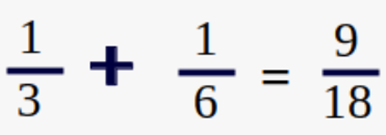
Use Our Online Calculators and Tools
Summary
The Lowest Common Denominator is a vital concept in mathematics, especially when performing operations involving fractions. It is the smallest number that two or more fractions share, and it is essential to find the LCD before performing any arithmetic operation involving fractions. There are different methods of finding the LCD, but the prime factorization method is the most common. By understanding the LCD, students can perform arithmetic operations with fractions accurately and with ease.