
Marginal cost is a fundamental concept in economics and business management, providing essential insights into the cost of producing an additional unit of a product or service. Understanding this concept is pivotal for making informed decisions about pricing, production levels, and optimizing operational efficiencies. In this guide, we’ll explore the nuances of marginal cost, its significance, and a step-by-step approach to calculating it, incorporating practical examples.
What is Marginal Cost?
Marginal cost represents the cost incurred by producing one additional unit of a product or service. It is a key indicator that businesses use to analyze the cost-benefit ratio of increasing production. By understanding marginal cost, companies can determine the most cost-effective production levels and set prices that enhance profitability.
Why is Marginal Cost Important?
- Pricing Strategies: Marginal cost is instrumental in setting prices that can cover production costs while ensuring profitability.
- Production Decisions: It aids businesses in deciding whether increasing production is financially viable.
- Cost Management: Understanding marginal costs helps companies optimize their cost structures and enhance operational efficiency.
- Profit Maximization: It plays a crucial role in identifying the point at which expanding production will maximize profits.
How to Calculate Marginal Cost
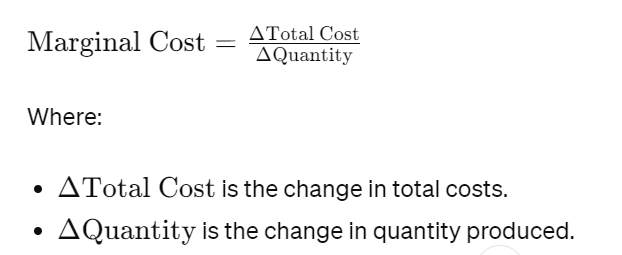
To calculate marginal cost, you need to assess the change in total production costs relative to the change in production output. Here’s the formula:
Step-by-Step Calculation
- Determine the Change in Costs: Calculate the difference in total costs before and after the production change.
- Assess the Change in Production: Find out how many additional units are produced.
- Compute Marginal Cost: Divide the change in total costs by the change in production quantity.
Example 1: Basic Calculation
Imagine a bakery that increases its production of cakes from 100 to 120. The total costs rise from $1,000 to $1,300.
- Change in Total Cost: $1,300 – $1,000 = $300
- Change in Quantity: 120 cakes – 100 cakes = 20 cakes
- Marginal Cost: $300 / 20 cakes = $15 per cake
The bakery’s marginal cost for each additional cake is $15.
Example 2: Detailed Scenario Calculation
Consider a clothing manufacturer planning to increase its production. The company is currently producing 1,000 units of clothing at a total cost of $50,000. The proposed plan is to boost production to 1,200 units. This increase involves several additional costs:
- Extra raw materials would cost $8,000.
- Increased labor costs due to additional shifts amount to $5,000.
- Additional utility expenses (like electricity and water) come to $2,000.
- The incremental wear and tear on machinery is estimated at $1,000.
Here’s how the marginal cost calculation would unfold:
- Calculate the Total Incremental Cost: First, sum up all the extra costs that come with the production increase. The total incremental cost would be $8,000 (raw materials) + $5,000 (labor) + $2,000 (utilities) + $1,000 (machinery) = $16,000.
- Determine the Increase in Production Quantity: The increase in production is from 1,000 to 1,200 units, which means there’s an increase of 200 units.
- Calculate the Marginal Cost: The marginal cost is the total incremental cost divided by the increase in production quantity. So, $16,000 divided by 200 units gives us a marginal cost of $80 per unit.
With this calculation, the company can ascertain that the cost of producing each additional unit of clothing is $80. This detailed analysis aids in understanding the financial implications of ramping up production, helping the company decide if the increase is financially prudent.
Calculating marginal cost is vital for any business aiming to optimize its production and pricing strategies. It provides a clear picture of the cost implications of producing additional units, enabling businesses to make informed decisions. While the calculations can be done manually, leveraging tools like a margin calculator can simplify and accelerate this process, allowing businesses to focus on strategic decisions and operational efficiency.
If you need to calculate margin check out our quick margin calculator.